
Why Crew Management Decides Your Run in Ostranauts
Crew management is the single system that turns an Ostranauts run from one-man scavenging to a fully crewed salvage operation, which is why our Ostranauts crew guide starts here: almost every late-game mechanic eventually loops back to whether your NPCs are alive, fed, paid, and willing to follow orders. Released into 1.0 on August 3, 2026 after Early Access since September 10, 2020, Ostranauts is a hardcore noir space-sim RPG from Blue Bottle Games that ships NPCs with physiological and emotional-needs engines rather than scripted behaviors (Kitfox Games via Steam).
Without crew, your single pilot cannot fly, repair, salvage, sell, and defend at the same time. With crew, you can take bigger derelicts, run longer routes, and earn the credits needed to retire the starter loan you took on at the K-Leg shipbreaking yard. This Ostranauts crew guide walks new and returning players through recruitment, skill training, daily tasking, morale, pay discipline, and recovery from disaster, building on what founder Daniel Fedor's seven years of AAA BioWare development suggest is a deliberate NPC-sim focus rather than a cosmetic system.
Where and How to Recruit Crew Members
Recruiting in Ostranauts happens at settlements, bars, and stations rather than from a menu, so knowing who can be hired, where, and for what wage saves you from burning your early ledger before you ever leave the dock.
Finding Candidates at K-Leg and Beyond
Most first-time captains pick up their first hire at K-Leg, where displaced dockworkers and ex-pilots drift between the canteen and the berths. You can also hire crew after you begin salvaging derelicts, since rescued NPCs sometimes accept a contract once you have patched their air and stopped the breach. The community has compiled the most reliable hiring pools on the Steam community guides hub, which is worth bookmarking once your fleet grows past a single ship.
Hiring windows vary by location type, so plan your trip around the role you actually need:
| Location Type | Crew Quality | Wage Range (community-reported) | Typical Roles |
|---|---|---|---|
| K-Leg docks | Low to mid | 50–120 cr/day | Dockhands, gunners |
| Inner-system bars | Mid | 90–180 cr/day | Pilots, engineers |
| Belt outposts | Mid to high | 150–250 cr/day | Combat veterans |
| Corporate stations | High | 300+ cr/day | Specialists, ex-officers |
Evaluating a Candidate Before You Sign
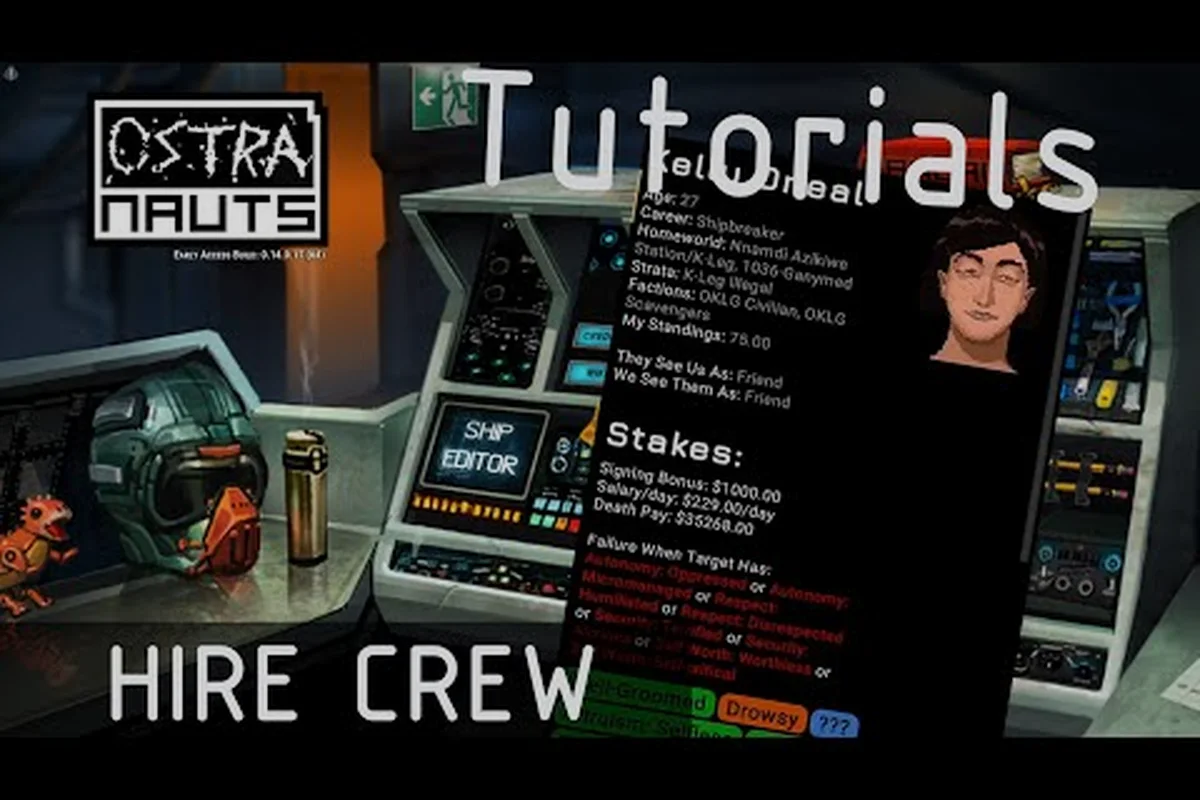
Before clicking Recruit, hover the candidate's profile and read three columns: Skills, Needs, and Promises. Promises are binding commitments the candidate expects you to honor, and breaking them is one of the fastest routes to desertion because they trigger an immediate morale swing rather than a slow drain. A common early-game mistake is offering top wages plus extra rations to a low-skill candidate, since the wage ceiling sets the baseline every later hire expects.
A quick candidate-evaluation shortcut players share in the Discord:
- Skill floor of 30 in their primary role keeps the new hire useful on day one.
- Low alcohol or stim dependency means they will not glitch out mid-docking.
- Two or fewer unmet needs is the practical ceiling; three is a desertion risk.
- Promises you cannot keep short-term are a red flag — counter-offer on wages instead.
Related reading lives in our Ostranauts NPC AI guide, which expands on how candidate stats predict behavior over a long playthrough, particularly around the Loneliness and Curiosity trait meters that show up on most mid-tier applicants.
Crew Skills, Roles, and Daily Tasks
Once aboard, crew skills grow through doing rather than menus, so tasking matters more than leveling widgets. Our Ostranauts crew guide treats the daily task board as the real training ground, because skills only improve when the matching task is the crew member's primary assignment for multiple shifts in a row.
Piloting, Engineering, Gunnery, and Beyond
There are seven skill families in the current 1.0 build, and they scale from 0 (untrained) to roughly 100 (specialist). The relevant ones for a fresh captain look like this:
| Skill | Primary Task | Effect at 50 | Effect at 80+ |
|---|---|---|---|
| Piloting | Wheel/stick | Cleaner docking turns | Newtonian precision burns |
| Engineering | Repair, recharge | Fast patch cycles | Cheaper field repairs |
| Gunnery | Turret fire | Hits small targets | Reliable against fighters |
| Mechanics | Salvage cuts | Faster strip-down | Bonus yield on parts |
| Medical | First aid, surgery | Stabilizes wounds | Field surgery capability |
| Trading | Negotiate prices | +5% margin | +15% margin and rumor tips |
| Command | Morale, discipline | Halves slow desertion | Catches mutiny early |
Players report that Piloting and Engineering scale the steepest early because every derelict trip uses both. Trading does not pay off unless the candidate starts with a Commerce trait or a merchant background, which is why most captains train trading in-house rather than hire for it outright.
Tasking Crew Efficiently
Open the Task Board and assign at least one primary and one secondary task per crew member each shift. A balanced four-crew load looks like this:
- Pilot 1: primary wheel, secondary communications watch
- Engineer 1: primary repair, secondary recharge
- Gunner 1: primary turret, secondary cargo inventory
- Engineer 2 (once you can afford them): primary salvage, secondary medical backup
Running a single-task-only assignment looks efficient in the moment but starves half your skills, so by month two you will see flat growth curves that even generous pay cannot fix. The compounding effect is real: a captain who rotates tasks through role-appropriate primaries will reach skill 80 in two months, while the single-task captain often sits at skill 45 in the same window.
Morale, Pay, and the Needs System
The biggest difference between losing a crew and keeping one for a year is how you treat morale, pay, and the neurochemical need meters, so this section of the Ostranauts crew guide focuses on those three dials and how they interact under pressure.
The Four Needs Every Crew Member Has
Each NPC tracks Hunger, Thirst, Rest, and Stress, plus a fifth variable tied to personality: a long-term need that might be Addiction, Loneliness, Curiosity, Faith, or anything in between. These meters tick down in real time even when the ship is docked at K-Leg, which is why sitting idle for a month without restocking is a soft form of crew abuse that the morale system does not forget once you start running cargo again.
| Need | Decay Rate | Critical Threshold | Recovery Action |
|---|---|---|---|
| Hunger | ~12 hours | 25% | Rations / galley meal |
| Thirst | ~8 hours | 30% | Water recycler / drinks |
| Rest | ~24 hours | 20% | Bunk rotation |
| Stress | varies by event | 40% | Quarters, pay, downtime |
| Personality need | slow | 10% | Trait-specific item or activity |
Crossing a critical threshold triggers a meltdown event that ranges from mild insubordination to outright combat depending on the crew member's willpower stat, so the cheap fix is always to stock enough rations and water to ride out a long haul between stations.
Wages, Promises, and Why Promises Hurt More
Pay is a flat daily deduction that fires whether you are docked or jumping. Promises are different: they are qualitative commitments the NPC tracks, and breaking one instantly tanks morale rather than slowly draining it. Community testers call the worst offenders broken promises because they convert a 70-morale hire into a deserter in about a day, and the captain cannot talk their way back from the worst ones.
Avoid the most common promise failures reported across long runs:
- Promising a share of salvage before the trip in numbers you cannot quantify at hire time
- Promising safety and then sending the crew into a depressurized derelict without an EVA suit
- Promising shore leave at an outpost you have no scheduled route to
A practical rule of thumb is to bind wages and bonuses in cash rather than in promises you can break, because cash mistakes recover while a reputation for breaking promises does not — your next hire at the same station will have heard about it, and their starting morale will arrive at -20 if your last three candidates all walked.
How Crew Workloads Interact With Salvage Runs
Crew do not exist in a vacuum, which is why an Ostranauts crew guide naturally pairs with a salvaging rotation. When your engineer finishes a strip-down on a derelict, send the gunner to inventory the loot while your trader tags anything that looks like a buyer lead — this is the routine our Ostranauts salvaging guide covers in more depth. The crew management takeaway is that each specialization multiplies the others: an uncrewed ship leaves three of four skill families idle, and a one-crew ship is barely better.
Common Crew Problems and How to Solve Them
Every Ostranauts save eventually loses a hire, so our Ostranauts crew guide lists the patterns that show up most often in community reports and pairs each with a fix you can apply on the same shift rather than across a multi-day recovery plan.
Desertion, Unhappiness, and Slow Bleed
Crew desert for three main reasons: an unmet personality need, a broken promise, or a better offer at the next station. The first two are captain errors that you can prevent with better reading of the candidate profile; the third is market pressure, and the workaround is to keep wages within 10% of local rates rather than overshoot once and reset everyone's expectations forever.
| Symptom | Likely Cause | First Fix | Second Fix |
|---|---|---|---|
| Sudden morale drop | Broken promise | Apology + small bonus | Reduce future risky tasks |
| Slow drift over weeks | Unmet personality need | Gift the trait item | Replace via transfer station |
| Mid-flight exit attempt | Threat or fear event | Reassign to safer role | Split-shift with another crew |
| Pay dispute at station | Local rates risen | Match the rate | Bump title to "Senior" |
Death, Injury, and Recovery
Death in Ostranauts 1.0 is permanent for the run, and injuries can sideline a crew member for dozens of in-game days. Stock your medbay with two surgery kits and three stabilizer doses per crew member so a single hull breach does not cascade into a body-bag situation, because the gap between a stabilized patient and a corpse is roughly two failed skill checks. Injured crew drop to about half efficiency until fully healed, so plan around them rather than through them.
The fastest recovery path is the Field Hospital service at K-Leg, which costs roughly 600 credits per critical patient but returns them in days rather than weeks. For captains on tighter ledgers, the broader crew management breakdown walks through self-recovery options using your own Medical-skilled crew, which is one of the best arguments for training at least one medic in the early game.
The Command Skill Trap
A common trap is dumping early skill points into Command because Command helps morale. In practice, Command only catches desertion events; it does not raise morale, and a captain with Command 80 and Engineering 10 cannot field-repair a reactor breach. Balance Command against the practical skills your ship actually needs this week, not the ones you wish you had on a flagship you cannot yet afford, because the loan officer does not accept morale as a payment plan.
Growing Past Five Crew Members
Past a crew of five, the meta shifts from individual management to shift patterns, quarters, and role redundancy. This is where the Ostranauts crew guide tips over into fleet thinking rather than single-ship thinking, and where most captains either stabilize a roster for the long run or watch their hire list churn every two weeks.
Quarters, Shift Rotations, and Conflicts
Without enough bunks, crew will fight over bunks, which feeds the Stress meter and creates a cascade that touches every other need. The fix is straightforward: keep bunk count at 1.5× crew size, schedule two-shift rotations, and isolate personality conflicts by reading the Social tab before assigning roommates. Social incompatibility is a hidden stat that new captains miss because it does not appear until the first month of overlap, by which point the damage is already a flat -10 morale.
| Crew Size | Bunk Minimum | Watch Stations | Recommended Split |
|---|---|---|---|
| 1–3 | 3 | 1 | Single watch, no rotation |
| 4–6 | 6 | 2 | Two shifts of 3 |
| 7–10 | 10 | 3 | Senior/crew split with one floater |
| 11+ | 14 | 4 | Full department model |
Promotion, Pay Grades, and Retention
Once a crew member reaches skill 80 in their primary role, they expect a title change or a pay bump — usually the first, since titles cost almost nothing and lock in morale for 30+ in-game days. A pay bump is the better lever when the captain needs cash flow tight for a big loan payment that the title change alone cannot justify, because titles help morale while pay helps retention under competitive offers.
Long-term, the captains who finish the loan and retire the ship tend to invest in three to four fully-trained veterans rather than a roster of nine rotating hires, and that ratio is the single best takeaway our Ostranauts crew guide can offer the captain still running a lean roster. A four-veteran crew at skill 80+ will outperform a nine-rookie crew in every measurable category except headcount, which matters only when you can afford the wage bill to back it up.
Frequently Asked Questions
How many crew members should I hire first in Ostranauts?
Most community pilots start with two crew on day one — one engineer and one gunner — then add a dedicated pilot around day five when their own piloting skill stabilizes. Two specialists on a starter ship produce more net credits per hour than three average hires, because skills at 50 or higher in their primary role out-perform three mediocre 25s across every task board rotation.
Can crew die permanently in Ostranauts?
Yes. Death is permanent in the current 1.0 release, and injuries can sideline a crew member for weeks. Always carry at least two surgery kits and rotate injured crew off high-risk tasks until they are fully healed, especially before any deep-belt salvage run where one hull breach can become three casualties if the medical kit is empty.
Why does my crew keep deserting after I pay them on time?
On-time pay only handles one of three desertion triggers. The other two are unmet personality needs and broken promises, which is why a captain who pays well but ignores a crew member's cravings will still lose them within a month. Track the personality-need meter the same way you track hunger and thirst, because the warning signs show up roughly ten in-game days before the desertion event triggers.
How do I raise crew skills fastest?
Assign primary tasks in the relevant skill and avoid double-tasking, which measurably slows growth. Players report roughly 0.4 skill points per in-game hour of focused work, so a dedicated pilot gains a full skill level every four to five days of steady shifts, while the same pilot gains only half that when split between piloting and turret duties on the same shift.
Is it worth hiring expensive corporate-station crew?
Only after your ship loan drops below 30%, because their 300+ cr/day wages will dominate your ledger before that threshold. Late-game captains can clear it comfortably, but early-game hires should stay under 200 cr/day unless the candidate already has skill 60+ in a role you need today, since a cheaper rookie trained in-house catches up by month three at a fraction of the wage bill.