
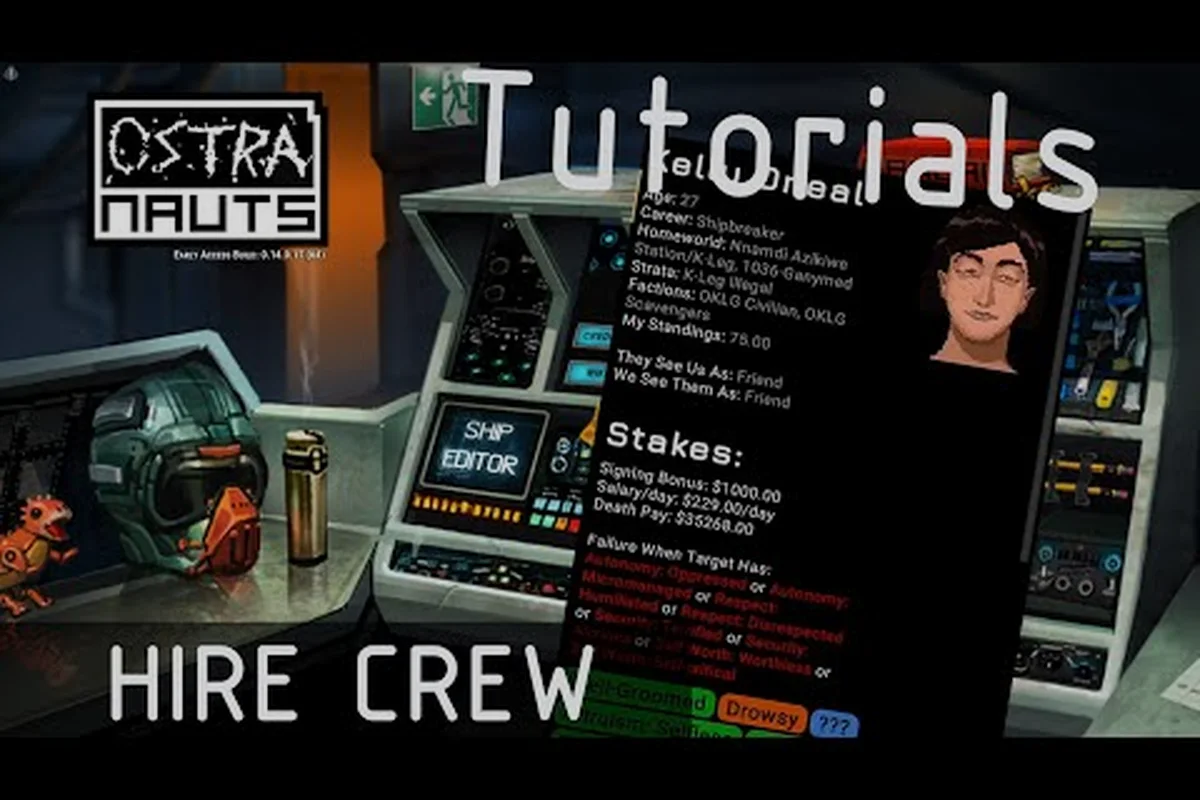
Ostranauts throws new captains straight into NEO Scavenger's unforgiving universe with a leaky hull and a paycheck that won't quit. Crew survival hinges on Ostranauts physiological needs, a layered system that punishes neglect with morale crashes, work stoppages, and ugly deaths during long-haul salvage runs. Understanding how hunger, thirst, sleep, and hygiene interact gives you the leverage to keep a paid crew productive instead of panicking. This guide breaks down every vital stat, the environmental factors that drain them, and the shipborn systems that refill them.
What Are Physiological Needs in Ostranauts
Every NPC on your ship runs on a battery of vitals that simulate realistic human biology. When those vitals drop, the crew member's efficiency tank and their Sentiment score spirals, which can snowball into mutiny, abandonment, or a corpse floating through the airlock. The system deliberately mirrors real human limits because Blue Bottle Games wanted survival pressure to feel earned rather than abstracted.
The core vitals tracked by the engine include:
- Hunger — fuel reserves in the body, drained by time and exertion
- Thirst — hydration level, drops faster than hunger under heat stress
- Tiredness — accumulated fatigue, gated by sleep cycles
- Bladder — short-term waste, triggered by liquid intake
- Hygiene — long-term cleanliness, falls from exposure to grime and waste
- Health — composite damage / wound state, not strictly a need but driven by unmet needs
Community data from the official Ostranauts wiki confirms these vitals drive the AI's goal selection, meaning a thirsty crew member will sometimes abandon a repair job to hunt for water. Because the ship acts as a closed ecosystem, you have to engineer the environment, not just hand out rations.
Core Vital Stats That Drive Crew Behavior
Each physiological need has a numerical range, a decay rate, and an urgency threshold that the AI reads before queuing up new behaviors. The table below summarizes the four most influential vitals based on community testing and the developer documentation shipped with version 1.0.0.7.
| Vital | Decay Pattern | Critical Threshold | Immediate Consequence |
|---|---|---|---|
| Hunger | Slow, steady over in-game hours | ~20% remaining | Crew member stops work to seek food |
| Thirst | Faster than hunger, accelerated by heat | ~25% remaining | Performance penalty, panic dialogue |
| Tiredness | Builds during any activity, even idle | ~15% remaining | Involuntary sleep, can collapse mid-task |
| Hygiene | Gradual, worsens near waste or fluids | ~10% remaining | Stress debuffs, social withdrawal |
The exact percentages shift slightly with patches, but the hierarchy is stable: thirst kills fastest, hunger kills slowest, and tiredness interrupts whatever the crew is doing the moment it bottoms out. Players who treat these as a simple checklist often lose crew members to a cascade where one unmet need triggers a behavior that worsens another.
How Hunger and Thirst Interact
Thirst and hunger are not independent sliders. A well-fed crew member who drinks contaminated water can still crash because Thirst triggers a separate urgency response independent of caloric intake. Ship rations refill Hunger cleanly, while refillable canteens, sinks, and the Water Recycler module target Thirst. Many first-time players overlook Thirst because the UI bar for it sits behind a tooltip, which is why community guides recommend keeping at least one drink station per crew module.
Sleep Cycles and Fatigue
Tiredness is the most disruptive vital because it forces involuntary downtime. Once a crew member's fatigue crosses the critical threshold, the AI drops whatever task is queued and routes the character to the nearest bed or chair. If no bed is available, the crew member sleeps on the floor, which builds a Hygiene penalty and can cause social complaints from other crew. The Ostranauts crew needs system page covers how the AI prioritizes competing needs; in short, the engine always resolves a fatigue emergency before a hunger emergency.
Environmental Hazards That Drain Physiological Needs
Your ship is not a neutral container; it actively erodes crew vitals through pressure, temperature, atmosphere, and waste. The Ostranauts engine models each room's atmosphere and surface independently, which means a hull breach in the cargo bay can drain oxygen in the galley only if the airlock doors are open.
| Hazard | Affected Vital | Typical Cause | Mitigation |
|---|---|---|---|
| Hull breach | Health, Hygiene | Combat, collision, salvage accident | Repair kit, sealed bulkheads |
| Heat spike | Thirst, Hygiene | Engine room overheating, solar exposure | Atmosphere Regulator, ventilation |
| Waste accumulation | Hygiene, Tiredness | Broken toilet, clogged drain | Plumbing repairs, dedicated janitor crew |
| Low oxygen | Health, Tiredness | Life support failure, airlock open | Backup tanks, sealed compartments |
The starboard corridor of your starter K-Leg tub is notorious among veterans for founding a mini-disaster chain: a clogged drain raises humidity, humidity drops Hygiene, low Hygiene drags down Sentiment, and the crew member decides to vent their frustration by punching a panel that cracks a pipe. Recognizing the upstream cause is the difference between a productive shift and a salvage claim.
Ship Systems That Refill Physiological Needs
Building a ship that actively restores vitals is the long-game goal of any captain serious about survival. The ship builder is grid-based, and rooms can be linked via doors, vents, and conduit runs that ferry power, water, and air. The table below maps common facilities to the vitals they serve.
| Facility | Restores | Operating Cost | Placement Tip |
|---|---|---|---|
| Galley | Hunger | Food stores, power | Central, near crew quarters |
| Water Tap / Sink | Thirst | Pipes from recycler | Adjacent to galley |
| Bunk Bed | Tiredness | None | Private room preferred |
| Shower / Sink combo | Hygiene, Thirst | Water, power | Near bathroom |
| Toilet | Bladder | Water, waste plumbing | Must connect to drain |
| Water Recycler | Source water for taps | Power, filter | Engine-adjacent |
The trick is balancing storage against throughput. A galley with three days of food but no recycler will eventually dry out the taps, and a row of toilets without a working drain will spread Hygiene disasters across the entire deck. Players on the official forums report that the simplest reliable layout places galley, water tap, and recycler in a single corridor with bunk beds branching off, because the AI pathfinds shorter routes when vitality urgencies pile up.
Crew Roles and Need Management
Assigning crew roles is half the battle. Each role has a default priority that affects how the AI schedules need-versus-work trade-offs:
- Engineer prioritizes repairs over personal comfort, which means engineers often ignore Tiredness until they collapse
- Pilot eats and drinks on a tighter schedule because the role demands alertness, but they fight fatigue poorly
- Guard will tolerate low Hygiene longer than other roles, but breaks down faster when Tiredness bottoms out
- Janitor actively maintains Hygiene across the ship, indirectly supporting other roles' Sentiment scores
The Ostranauts emotional needs article covers the psychological half of the system, but the rule of thumb is that a crew member who regularly hits a critical threshold stops trusting the captain's leadership, which leads to payroll disputes.
Strategies for Long-Haul Physiological Management
Long salvage runs, deep-belt mining contracts, and trips past Jupiter push the closed ecosystem to its limits. These strategies come from community-tested playthroughs and the developer blogs during the 1.0 release cycle.
Stockpile Ratios Before Undocking
Before undocking from K-Leg or any port, confirm a stockpile ratio that sustains your crew for the planned duration plus a 30% buffer. Community testing suggests a baseline of 1.5 rations per crew member per day, 2 liters of water per crew member per day, and one soap or cleaning unit per week for every hygiene-capable facility. Skipping the buffer leaves zero room for a broken recycler or a delayed contract.
Rotate Sleeping Shifts
Stacking sleep on the same eight-hour block means an entire crew sleeping at once, which leaves the ship unmanned during quiet segments. By contrast, staggered bunk rotations keep a skeleton crew productive while hungry crew members queue at the galley. The effects compound: a well-staggered ship sees roughly 20% higher task throughput because repairs never wait for a wake-up cycle.
Monitor Vitals Through the Crew Panel
The crew panel shows every vital in real time, color-coded by urgency. A green bar with a slight downward slope is fine; a yellow bar in a non-critical vital is a warning sign that needs pre-emptive action. Players who ignore yellow bars usually face a red bar within a single shift, which is the moment the AI starts overriding player-assigned tasks.
Build Redundancy Into Critical Systems
Water recyclers, atmosphere regulators, and galley stoves should be doubled up on any ship longer than a one-shift run. A single recycler failure halts the entire water supply chain, and if the galley stove breaks, your crew eats cold rations, which actually drains morale faster than skipping a meal. For ships that venture past the belt, players recommend three sources of water minimum: a recycler, a bottle stockpile, and a secondary tap connected to a reserve tank.
Pair With the Right Starting Knowledge
If you are still learning the basics of resource flow and ship layout, the Ostranauts beginner guide walks through your first day on K-Leg. Returning captains who want a refresher on resource acquisition should check the Ostranauts getting started walkthrough, which covers how to fund the first round of galley and recycler upgrades.
Read the Room for Crisis Warning Signs
Long before a crew member's vital hits zero, the game spawns dialogue complaints and Sentiment drops. A crew member who mumbles about bad water for two shifts is a sentinel; if you do not fix the underlying tap or recycler, the next escalation is a fight, a strike, or a quiet sabotage event. Listening to the chatter is the cheapest diagnostic tool in the game.
Frequently Asked Questions
What does Ostranauts physiological needs actually track?
The system tracks hunger, thirst, tiredness, hygiene, bladder, and overall health. Each vital decays at its own rate, and the AI reads the urgency of every vital before queuing tasks. According to community data, thirst is the fastest to fall, while hygiene is the slowest but carries the heaviest social penalty when neglected.
How fast do crew members get hungry or thirsty?
Hunger decays over several in-game hours, while thirst drops measurably faster, especially when the ship's internal temperature rises. A crew member performing heavy labor will burn through both faster than a crew member on rest rotation. With no food or water sources, expect a crew member to enter critical territory within a single standard shift.
Can a crew member die from neglected physiological needs?
Yes. Once any vital hits zero for a sustained period, the crew member's health begins to drop, and a dead NPC is removed from the crew roster. The death is permanent for that playthrough, which is why experienced captains treat the yellow vitality warnings as a hard stop rather than a soft suggestion.
Do I need to assign crew to eat, or do they do it automatically?
The AI handles autonomous need satisfaction, but the quality of the choice depends on the facilities available. A crew member with a working galley, full rations, and a clean tap will eat and drink on a healthy schedule. Without those facilities, the same crew member will improvise badly, which usually means eating raw rations or skipping a drink entirely.
Does cargo weight affect crew physiological needs?
Cargo weight does not directly drain vitals, but a heavy load extends voyage time, which exposes every crew member to more decay cycles. A 40-tonne cargo run can drain the same stockpile a 20-tonne run would, even though the per-day consumption rate is unchanged. Planning long-haul weight against stockpile depth is part of the closed-ecosystem puzzle the game is designed around.